

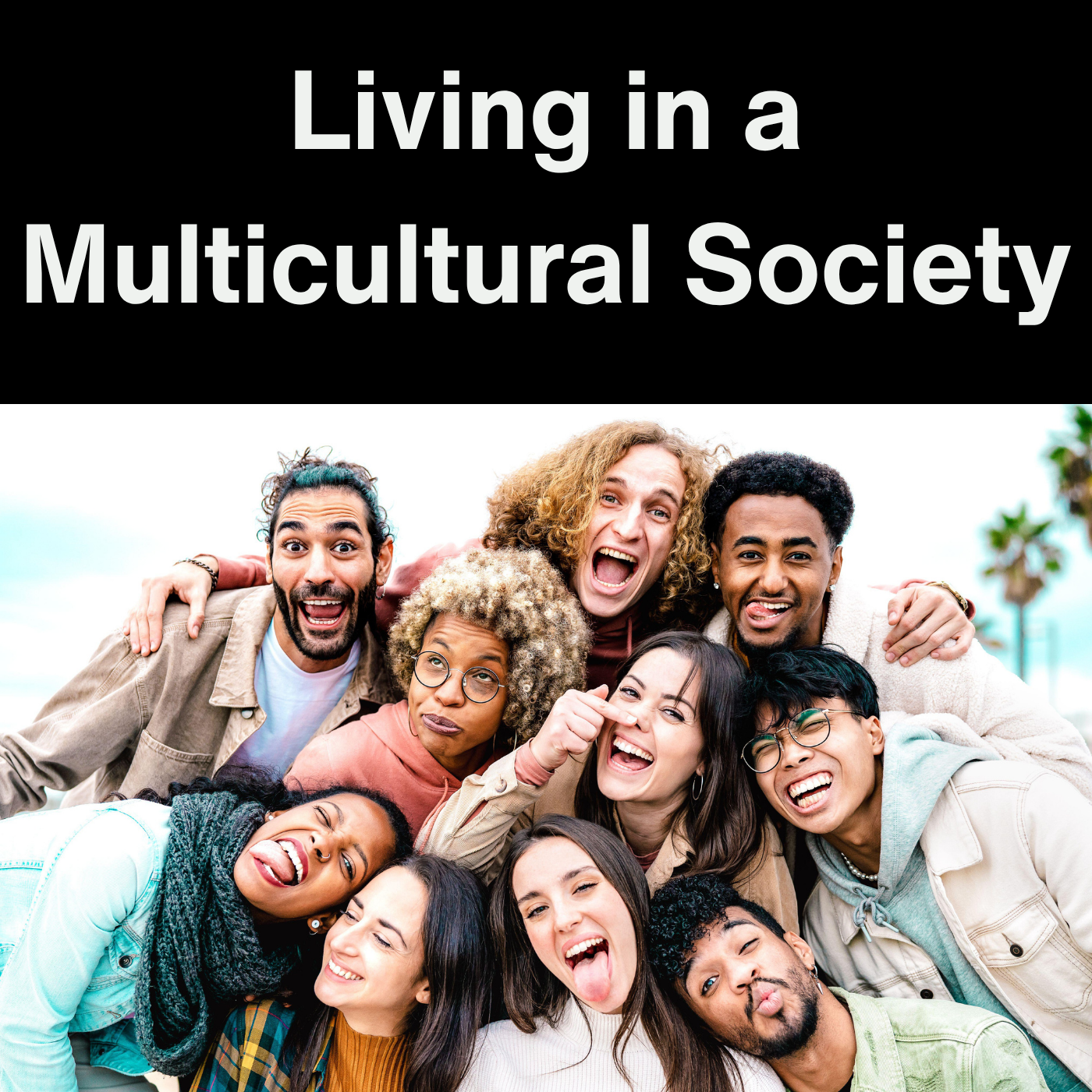
The world has never been more connected. Whether you live in a large city or a small town, you’re likely to meet people from different countries, cultures, languages, and backgrounds.
This diversity has brought exciting opportunities, but it has also raised important questions. How do different cultures live together? What are the benefits of multicultural societies? Are there challenges? And how can learning English help us communicate across cultures?
In today’s episode, we’ll explore the idea of multiculturalism, learn useful vocabulary and expressions, and discuss some thought-provoking questions that will help you express your own opinions in English.
Voice message from Marta from Poland
undergoing urban regeneration
one of the most ethnically and religiously homogeneous countries in Europe
to mark a turning point
multiculturalism – the challenges and opportunities
What is multiculturalism?
A society where people from different cultural, ethnic, religious, and linguistic backgrounds live together while maintaining aspects of their own cultural identity. It’s not only immigration, it includes language, tradition, food, religion, customs, music, festivals and values.
Vocabulary
Diversity – The presence of many different people or ideas.
Ethnicity – A person’s cultural or ancestral background.
Race – a person’s physically inherited traits, such as skin colour, eye shape, etc. (You can be mixed race – like Reza!)
N.B. Two people can have exactly the same race but have different ethnicity.
Example 1: a Jamaican person whose ancestors came from Nigeria 250 years ago and a Nigerian who has always lived in Nigeria. Same race, different ethnicity.
Example 2: the Saami of Finland are exactly the same race as the Finns, but are a different ethnicity, including a different dialect.
Heritage – The traditions and history passed from one generation to another.

Religious beliefs – this includes not only distinct religions, but also sects within one religion. (Lebanon, created as a country in 1920, is an interesting case. In the only census ever undertaken, in 1932, the population was deemed to be 50-53% Christian, about 42-43% Muslim, about 6-7% Druze and just under 1% Jewish. If we further subdivide the Chrisitian populace into sects: Maronite Catholics 29%, Greek Orthodox 10%, Greek Catholics 6%, other sects 5%. And the Muslims: 22% Sunni, 19% Shia. Remember, the country was founded with these demographics – the complex mixture didn’t start after foundation. Today, the estimated figures are different: about 66% Muslim, 30% Christian, 4-5% Druze)
Inclusion – Making everyone feel welcome and valued.
Integration – becoming part of society while maintaining your culture.
Assimilation – gradually adopting the dominant culture, often giving up parts of your original identity.
Naturalisation – the legal process of a country granting citizenship to someone not born in that country after a period of time
Residency – this can be temporary or permanent. Not to be confused with naturalisation. Residency might qualify you for a residence card/permit, or maybe even a national ID card, but not a passport (as Reza and Craig know)
A melting pot – a place where many different people and ideas exist together, often mixing and producing something new
Benefits of multiculturalism
Exchange of ideas
Economic growth — Immigration and cultural diversity can expand labor markets, stimulate entrepreneurship, and increase productivity
Great food, above all as regards variety
Greater global awareness
Broadening of perspectives
Challenges of multiculturalism
Workplace expectations due to things like punctuality, personal space and other cultural differences
Difficulties accessing services such as medical care, schools and housing
Language barriers
Intercultural problems
Discrimination and prejudice
Ghettoisation – this isn’t always due to immigrants being excluded from living in many areas but sometimes, in fact, the immigrants not wishing to integrate with locals
Risk of inequality — Without careful management, diversity can coexist with discrimination, marginalization, or unequal access to opportunities.
Discussion
Should immigrants be expected to adopt the language, customs, and values of their new country, or is that an unreasonable expectation?
Has there ever really been such a thing as a pure race or ethnic group?
(Food for thought – contemporary English – never mind British – culture is usually defined as developing from Anglo-Saxon traditions. Uhm! So is that just the Angles or just the Saxons or what?! And the Saxons were originally from Germany!)
When newcomers move to a country, whose responsibility is it to integrate, the newcomers’, the local population’s, or both equally?
Are generalisations about certain races or ethnic groups valid or useful?
Have you ever changed your opinion about another culture after meeting someone from it? What did you learn?
Is multiculturalism a success in the UK, or is it failing?
Should employers be allowed to ban religious clothing or symbols at work if they want a “neutral” appearance?
…and now it’s your turn to practise your English. What do you think? Can a country have open borders and a strong national identity?
Send us a voice message. https://www.speakpipe.com/inglespodcast
Send us an email with a comment or question to craig@inglespodcast.com or belfastreza@gmail.com
If you’re a Spanish speaker and you want to improve your English with free and paid resources, visit the mansioningles website at mansioningles.com and for paid products you can browse the online store at https://store.mansioningles.net/

If you would like a full transcription of this podcast you might consider joining our Patreon program. As a Patreon member, you’ll receive the full transcription by email every week so that you can read every word that we say and you’ll get a monthly invitation to join Craig for an informal chat on Zoom to practise your speaking. https://www.patreon.com/inglespodcast

Welcome to our new Patreon supporters who have joined us this month:
Aleksandra Jurczak
In next week’s episode: Why English jokes are funny: learn English humour and wordplay
If you enjoyed this podcast, please tell your friends.
The music in this podcast is by Pitx. The track is called ‘See You Later’