


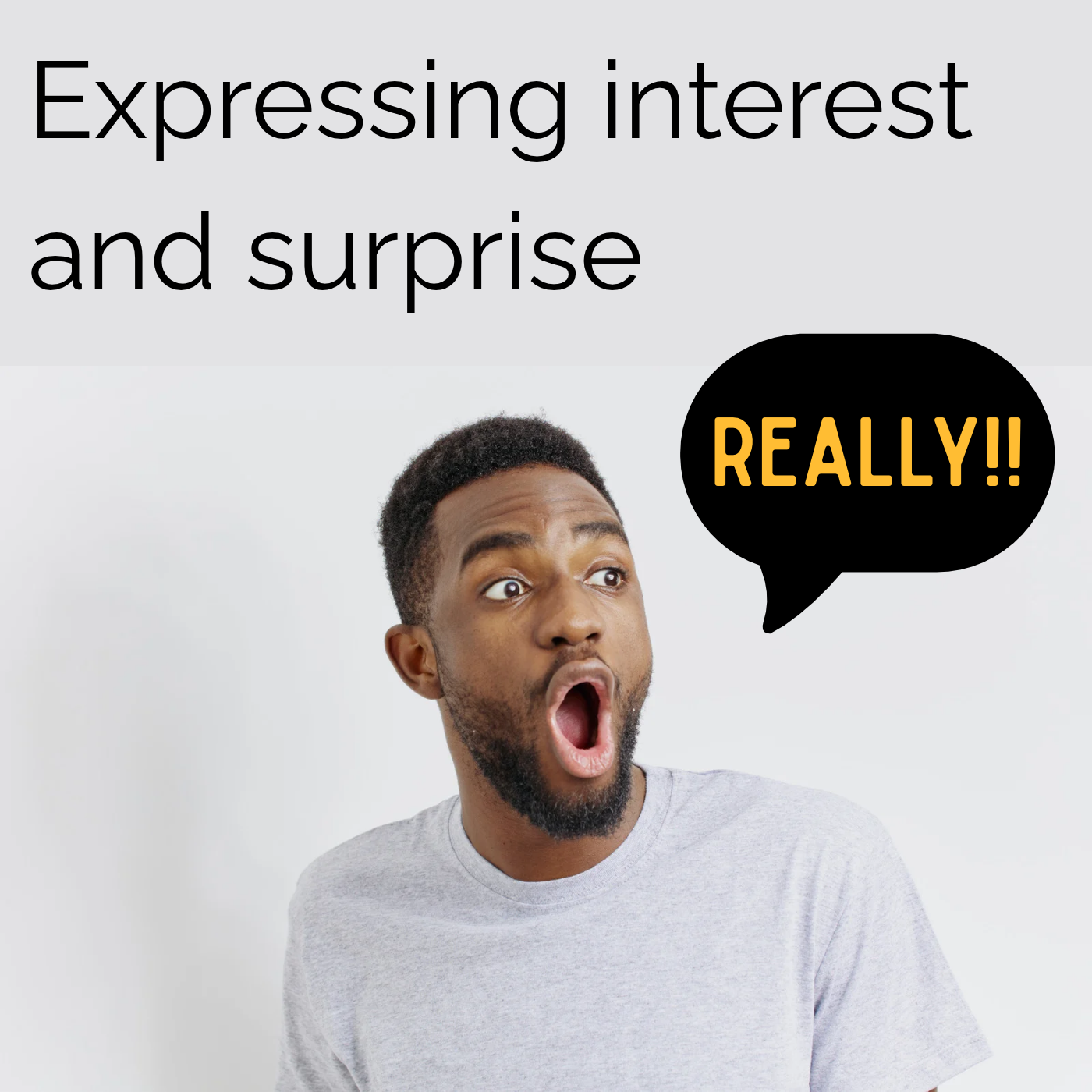
Have you ever heard some surprising news and not known what to say? Or found yourself replying “Really?” to absolutely everything? Well, today we’re looking at how to express interest and surprise in natural English. From “Has he?” to “You’re joking!”, we’ll explore the little expressions that make conversations more lively.
Voice message from Valentina from Romania.
Reza and Craig’s Christmas Special (with a few Christmas jokes at the end)
https://inglespodcast.com/82
What do you call people who are afraid of Santa? – Claus-trophobic!
What does Santa call his little helpers? – Subordinate Clauses!
Email from Enrique from Seville
Hi there, Craig and Reza!
It’s Enrique here from Seville. Firstly, I would like to announce to you that I’ve finally passed my writing exam, and now I’m a proud C1.1 student at the Official Language School in Seville. You’re part of that success, so let me say… thanks for your content and your support.
Expressing interest and surprise
Echo questions:
“Has he?”, “Is it?”, “Did you?”
One of the most common ways of expressing interest or surprise is to repeat the auxiliary verb from the previous statement, often with the subject pronoun.
Dave’s got a new car. – Has he?
Yes, it’s a Ferrari. – Is it?
He bought it brand new. – Did he?
Similar to tag questions, but a question tag is usually attached to a statement and the auxiliary verb is the opposite in the tag to the statement: “Dave’s got a new car, hasn’t he?”.
An echo response follows another person’s statement and the auxiliary verb mirrors that of the statement..
“Dave’s got a new car.” – “Has he?”
Tag questions: https://inglespodcast.com/
If there is no auxiliary verb, use do, does or did.
I bought these biscuits in Madrid. – Did you?
She works for Google. – Does she?
She’s getting married. – Is she?
They live in Canada. – Do they?
You’ve met my brother. – Have I?
They can speak Japanese. – Can they?
She’ll be here tomorrow. – Will she?
He’s been promoted. – Has he?
They weren’t invited. – Weren’t they?

Here’s a longer dialogue reacting to bad news (notice how the listener’s reaction keeps the conversation moving and shows surprise and sympathy).
A: We had a terrible holiday.
B: Did you?
A: Yes, the hotel was miles from the town centre.
B: Was it?
A: And there wasn’t any water in the bathroom.
B: Really? No! So what did you do?
A: We complained, and they moved us to a different hotel.
B: Did they? Well, at least they did something about it!
A: Unfortunately, the second hotel was even worse.
B: You’re joking!
A: I’m not. There was a nightclub right underneath our bedroom.
B: Was there? Oh, no!
A: And the music went on until five in the morning.
B: You’re kidding! That’s terrible!
A: We asked for our money back.
B: Did you? And did you get it?
A: Not a penny!
B: That’s unbelievable!
Don’t forget negative echo questions
Negative statements often produce negative echo questions, which are particularly useful for expressing surprise.
For example:
“I don’t like chocolate.” – “Don’t you?”
“She hasn’t arrived yet.” – “Hasn’t she?”
“He can’t speak Spanish.” – “Can’t he?”
Negative echo exclamations
In response to a positive statement, you can respond with a negative echo exclamation (not the same as a negative echo question) to show surprise
For example:
I finally asked Mary to marry me – You didn’t!
My sister’s stolen my laptop – She hasn’t!
I could run 5 miles without stopping when I was younger – You couldn’t!
I’m leaving my wife today! – You aren’t!
Apart from echo questions and exclamations, we also use a selection of expressions like “That’s terrible” and “Really?” to show interest and surprise. Here are some more examples:
Showing enthusiasm: “That’s amazing!”, “How exciting!”, “No way!”
“I see” — showing that you understand or are following the story.
“Right” — acknowledging information.
“Go on” — encouraging someone to continue.
“And then?” — asking what happened next.
“Get outta (out of) here!” — expressing surprise, very informal.
“No way, (José)!” — expressing surprise or enthusiasm or expressing refusal, very informal.
“You’re joking/kidding!” or “Are you joking/kidding?” – expressing incredulity or surprise, informal.
“You’re pulling my leg!” – expressing incredulity or surprise, informal.
“You don’t say!” — expressing surprise, sometimes with a humorous or ironic tone.
“Who’d have thought it!!” — expressing surprise, sometimes with a humorous or ironic tone.
“Fancy that!” — expressing surprise, often at something unexpected.
“Well, well!” – expressing interest at something unexpected or a sudden twist in a story.
“How interesting!” — showing interest, although the tone can sometimes sound formal or even slightly sarcastic.
“Tell me more!” — showing enthusiasm and inviting further details.
In natural conversations, we often don’t stop at short responses, we often combine it with a follow-up question:
Instead of just saying:
“Really?”
We might say:
“Really? How did that happen?”
Or:
“Oh, have you? What made you decide to do that?”
“No way! What were you thinking?!”
“Well, well! Now what are they going to do?”
That extra question makes the interest much more obvious.
Context and intonation matters. For example, “You’re joking!” can express delighted surprise, disbelief, or annoyance.
“I’ve won a million euros!” – “You’re joking! That’s incredible!”
“I’ve booked us a table at the restaurant you hate.” – “You’re joking!”
“They’ve increased the rent by 30%.” – “You’re joking!”
Here’s another example dialogue that combines surprise, disbelief, and follow-up questions.
A: Look! Roy’s drunk.
B: Is he?
A: Yes, he’s had half a bottle of whisky.
B: Half a bottle! How much has he had to drink altogether?
A: I’m not sure, but he doesn’t usually drink much.
B: Doesn’t he? How strange.
A: He can’t even walk straight.
B: Can’t he? How’s he going to get home?
A: Don’t worry. We’re going to get him a taxi.
B: Good idea. He certainly shouldn’t drive.
A: Well, he won’t be driving, will he? (question tag)
B: No, definitely not!
A final point: show interest without overdoing it
In natural conversation, we don’t need to react dramatically to every sentence. Sometimes a simple “Oh, really?”, “I see”, or “Do you?” is enough.
It’s also important to avoid making every response a question. We can show interest by adding a comment, expressing an emotion, or inviting the speaker to continue. For example:
A: I’ve just come back from Thailand.
B: Oh, really? What was it like?
A: Amazing. The food was incredible.
B: I can imagine! What was your favourite dish?
This combination of short reactions and follow-up questions makes the conversation flow naturally.
Also, don’t forget that “Really?” can sometimes sound sceptical or sarcastic. If someone says, “I’ve been working all day”, and you respond “Really?”, your tone may suggest that you don’t quite believe them.
…and now it’s your turn to practise your English. Why not send us a voice message and try some of the conversation expressions and techniques we’ve spoken about in this podcast.
Send us a voice message. https://www.speakpipe.com/inglespodcast
Send us an email with a comment or question to craig@inglespodcast.com or belfastreza@gmail.com
If you’re a Spanish speaker and you want to improve your English with free and paid resources, visit the mansioningles website at mansioningles.com and for paid products you can browse the online store at https://store.mansioningles.net/

If you would like a full transcription of this podcast you might consider joining our Patreon program. As a Patreon member, you’ll receive the full transcription by email every week so that you can read every word that we say. https://www.patreon.com/inglespodcast

In next week’s episode: Legal doping and robots: Is this the future of sport?
If you enjoyed this podcast, please tell your friends.
The music in this podcast is by Pitx. The track is called ‘See You Later’