

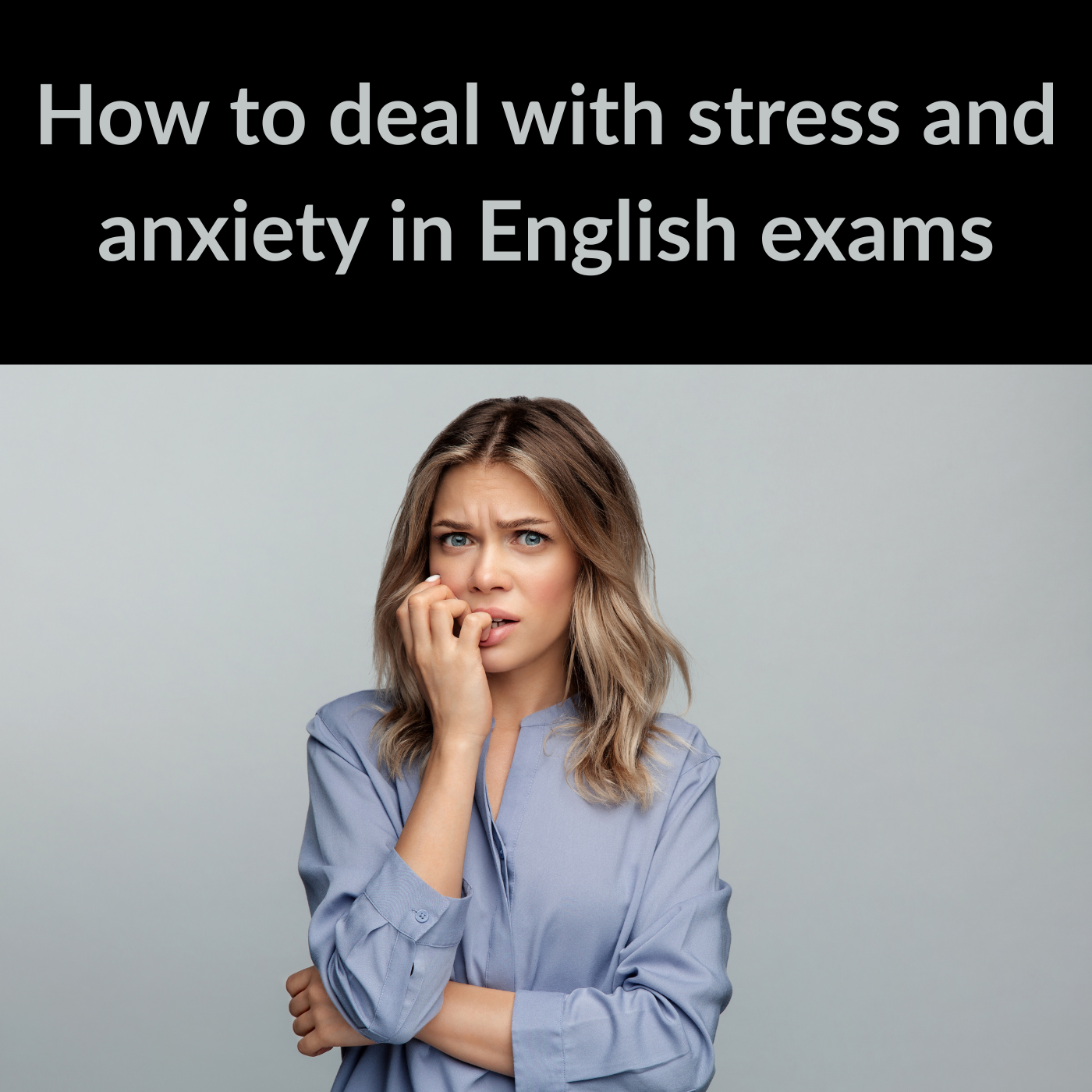
Have you ever walked into an English exam feeling prepared, only to find that your mind suddenly goes blank? Maybe you’ve forgotten vocabulary you use every day, misunderstood simple listening questions, or struggled to answer speaking prompts that would normally be easy.
If this sounds familiar, you’re not alone. In today’s podcast, we’ll explore why exam anxiety affects even highly capable English learners and what you can do before and during the exam to stay calm and perform at your best.
Voice message from Valentina from Romania
Taste of = real flavour from the thing
Taste like = flavour resembles the thing
This soup tastes of garlic. There is garlic in it.
This soup tastes like garlic. It reminds me of garlic; maybe it has garlic, maybe not.
We’ve received an email from Laura from Seville who recently had a bad experience while taking a C2 exam. Here’s what Laura wrote:
“I’m obsessed with passing C2 because I’m an English teacher, and I feel I wouldn’t be honest with myself and my students if I couldn’t demonstrate that I truly master the language at that level.
I failed the listening exam. I find it impossible to manage multitasking. I’m not able to listen to an audio, read a question with three long options, understand it, eliminate the wrong answer, choose the correct option and keep reading and listening. Most of the time I get lost.
I also failed the speaking exam. I felt terribly nervous, as if I was risking my life! I couldn’t stop thinking that I had to use C2-level English vocabulary and expressions during the preparation time. When I started my monologue, I said a sentence I had learnt by heart to introduce the topic and feel more confident, but it didn’t work.
Then, I felt intimidated by the inquisitive look of one of the examiners, and my mouth started to dry up. Afterwards, I stammered and felt embarrassed. I was the center of attention, and I didn’t want to be. I stopped talking. I couldn’t find the way to continue. I was suffering from stage freight. My classmates told me it only lasted 5 seconds but it felt like an hour to me. I did restart, though I cannot remember anything I said.
Another thing I’d like to highlight is that the other two candidates who were sitting the oral exam with me were much younger than me and came from different professional fields; however they performed their monologues beautifully.
I’d like to add that I trained myself for the exam and I used a timer and prepared many oral topics extensively.
I think I won’t be able to get the C2 certificate unless my brain is wired into a bilingual one, but is this possible? What am I doing wrong?
It ‘s hard. So hard. But it is what it is. Communication goes beyond language per se; it is an aptitude.”
Reza has just failed his C2 Valencian exam, with less than 50% in Listening. So we really do know how Laura feels!
Exam anxiety is normal. It is not a sign that you are weak, unprepared, or incapable.
When we perceive a threat, our brain activates the “fight, flight, or freeze” response.
Although an English exam is not physically dangerous, the brain may interpret it as a threat because:
We fear failure.
We fear embarrassment.
We fear disappointing ourselves or others.
We worry about future consequences (In Laura’s case, teaching her students and not feeling that she’s mastered the language)
The body responds by releasing stress hormones such as adrenaline and cortisol. This means you may experience a faster than normal heartbeat. sweaty hands, a dry mouth, shallow breathing, muscle tension and an uneasy and uncomfortable feeling in your stomach.
Has this ever happened to you?
Apart from physical symptoms, you might get mental ones, too. Like:
Difficulty concentrating (perhaps this is why Laura had difficulties with the listening)
Forgetting familiar vocabulary
Racing thoughts
Negative self-talk
Difficulty processing spoken information
Collapse in self-confidence
Anxiety is not always bad. A moderate level of stress can improve performance by increasing alertness and focus. Problems occur when stress becomes excessive.
The Anxiety Spiral (in the listening test – once words are spoken they are gone. You can’t go back several times to ‘re-listen’ like you can in the reading part)
Miss one word.
Start worrying.
Stop listening effectively.
Miss more information.
Anxiety increases.
Breaking this cycle is essential.
Common Myths About Exam Anxiety
Confident People Never Feel Nervous (athletes, actors, musicians, and public speakers all experience nerves)
Anxiety Means You Are Not Ready (many well-prepared students still feel anxious)
You Must Eliminate Anxiety Completely (the goal is not to eliminate anxiety, the goal is to perform effectively despite anxiety)
What can you do before the exam to reduce nerves and anxiety?
Practise Under Realistic Conditions
Timed practice tests
Speaking with unfamiliar partners
Simulating exam conditions
The more familiar the situation becomes, the less threatening it feels.
Normalise Mistakes – perfectionism creates anxiety, so go easy on yourself!.
….and remember:
Nobody answers every question perfectly.
Examiners expect occasional mistakes.
Communication matters more than perfection.
Focus on process, not outcome
Instead of thinking: “I must get a C2 score.”
Think: “I will focus on each question one at a time.”
Strategies during the exam
Use controlled breathing
Breathe in for 4 seconds.
Hold for 2 seconds.
Breathe out for 6 seconds.
Longer exhalations help calm the nervous system.
Ground yourself
Notice:
Your feet on the floor
Your chair
Your breathing
This brings attention back to the present moment.
Accept nervousness
Instead of fighting anxiety, acknowledge it. Say internally:
“I’m nervous, and that’s okay.” This often reduces its intensity.
Recover quickly from mistakes
If you miss a listening answer, don’t think “I’ve ruined the exam.”
Think, “That question is finished. Focus on the next one.”
Slow down in the speaking test
Many candidates speak too quickly when nervous.
A slightly slower pace:
Improves pronunciation
Reduces mistakes
Gives thinking time
Creates a more confident impression
Use strategic pauses
Native speakers pause all the time.
Useful phrases include:
“That’s an interesting question.”
“Let me think about that for a moment.”
“Let me think, I’ve never thought about that before.”
“There are several ways to answer that.”
These phrases buy valuable thinking time.
Final Thought
Never forget that you are capable of passing the exam even if you don’t pass it first time round.
The goal is not to become fearless.
The goal is to trust yourself even when you feel nervous.
Many successful candidates enter exams with butterflies in their stomachs.
The difference is that they have learned not to let those butterflies control their performance.
…and now it’s your turn to practise your English. Have you ever experienced something similar to Laura? What advice do you have? How did you overcome your nerves and find success?
Send us a voice message. https://www.speakpipe.com/inglespodcast
Send us an email with a comment or question to craig@inglespodcast.com or belfastreza@gmail.com
If you’re a Spanish speaker and you want to improve your English with free and paid resources, visit the mansioningles website at mansioningles.com and for paid products you can browse the online store at https://store.mansioningles.net/

If you would like a full transcription of this podcast you might consider joining our Patreon program. As a Patreon member, you’ll receive the full transcription by email every week so that you can read every word that we say and you’ll get a monthly invitation to join Craig for an informal chat on Zoom to practise your speaking. https://www.patreon.com/inglespodcast

Welcome to our new Patreon supporters who have joined us this month:
Juan Gonzalez
In next week’s episode: Bring, Take & Fetch Explained: Common Mistakes and Everyday English Expressions
If you enjoyed this podcast, please tell your friends.
The music in this podcast is by Pitx. The track is called ‘See You Later’