

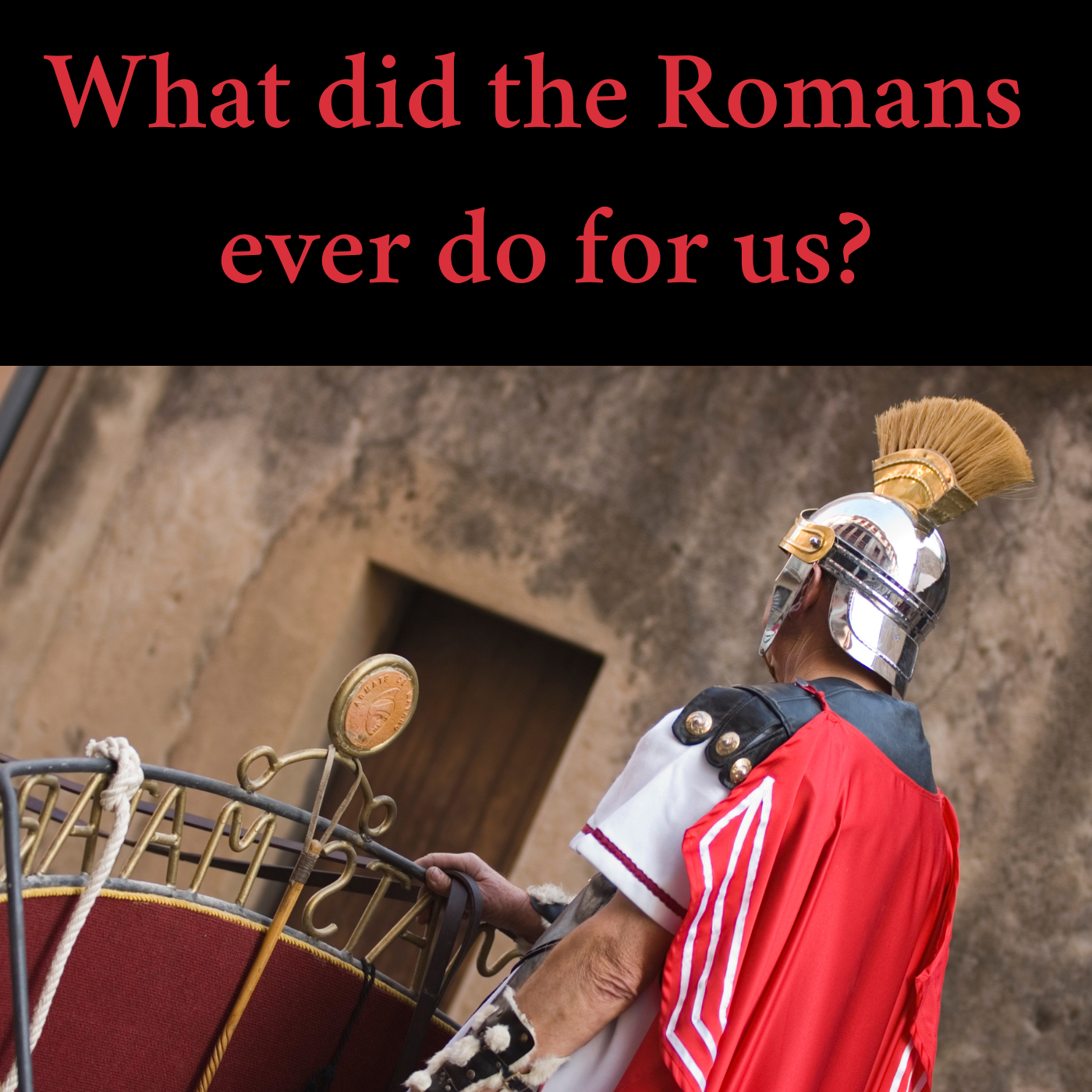
What did the Romans ever do for us?
We can see their influence everywhere: in the roads we travel on, the laws we follow, even the words we speak.
In this episode, we’ll explore how an ancient empire didn’t just conquer lands, it laid the foundations for modern civilization.
Email from Mati from Cartagena.
Hi again. This is Mati from Cartagena. How are you guys!!
I have a new topic for a future podcast in case you were running out of ideas.
You know that I work as a tour guide in my city and here, we have many Roman remains the same as in a large part of the peninsula.
So, the question is, what did (the) Romans do for us? Apart from roads, laws, wine, aqueducts or public order…
By the way, I had to do something similar when I took my speaking topic for the Trinity test, so I will be delighted to help you in case you need it!
Lots of hugs and health, Mati.
What did the Romans ever do for us?
Roads and Infrastructure
The Romans built an extensive road network connecting their vast empire.
The phrase “All roads lead to Rome” isn’t just a metaphor. They built over 400,000 kilometers of roads to facilitate trade (to pave the way for….) and rapid military deployment. Roman roads were built with a slight curve to allow rainwater to drain off, a technique still used in modern civil engineering.
Aqueducts and Water Supply
They developed advanced water management systems to supply cities.
The Romans introduced running water, public fountains and sanitation systems into many of the lands they conquered.
Some aqueducts carried water over 50 miles using gravity alone.
Rome’s “Cloaca Maxima” (Greatest Sewer) is one of the world’s earliest sewage systems and parts of it are still used for drainage today.
Law and Legal Systems
Roman law influenced many modern legal systems and provided a legal framework for civil law and a sound justice system which laid the foundations for modern law.
The concept of “innocent until proven guilty” comes from Roman law. Many Latin legal terms are still commonly used to this day in the English-speaking world: ipso facto (by that very fact); habeas corpus (a legal order to oblige appearance before a judge); a priori (from what went before); compos mentis (of sound mind); etc.
Architecture and Engineering
They revolutionised building with arches, vaults, and concrete. While various cultures used mortar, the Romans perfected a marine-grade concrete that could set underwater.
The Pantheon still has the world’s largest unreinforced concrete dome. It was built around 2000 years ago by Emperor Hadrian.
Public Baths and Hygiene
Romans promoted public health and cleanliness at a time when washing oneself was not common in Europe. Bathhouses were also social hubs—like modern gyms or cafés.

The Latin Language
The Roman Empire left a linguistic legacy. Latin became the basis for many modern Romance languages and laid the foundations for languages like Spanish, Portuguese, Catalan, Romanian, Romansh (Switzerland), French, and of course Italian, among others. Many languages, including English, still use words or phrases directly taken from Latin today. e.g. (exempli gratia): per se; ad hoc; pro bono; bona fide; i.e. = inter alia; quid pro quo; et cetera.
Calendar System
The Julian calendar was introduced by Julius Caesar to align with the solar year.
While the Gregorian calendar eventually replaced it, the Julian version gave us the 12-month structure and the leap year.
Interesting Fact: July is named after Julius Caesar, and August is named after Augustus.
Urban Planning
Roman cities were carefully organised. Urban planning was arranged in a grid system and the Romans included public spaces for socialising and sports.
Many urban planners today still follow the Roman-style layouts.
Postal System
They created an efficient communication network. They had to in order to communicate with their armies at the front line and ensure rapid communication across the empire.
The Welfare State (Annona)
The Romans were among the first to implement social safety nets. The Annona was a grain dole that ensured the poorest citizens didn’t starve.
“Bread and circuses” (panem et circenses)—the strategy of keeping the public happy through food and entertainment to distract them from political issues.
Entertainment and Amphitheatres
Romans developed large-scale public entertainment. This included gladiatorial contests, public spectacles, plays and mass entertainment.
The Colosseum in Rome could hold around 50,000 spectators.
Precursor to Newspapers (Acta Diurna)
Long before the printing press, the Romans had the Acta Diurna (Daily Events). These were carved stone or metal slabs displayed in public places.
…and now it’s your turn to practise your English.
Send us a voice message. https://www.speakpipe.com/inglespodcast
Send us an email with a comment or question to craig@inglespodcast.com or belfastreza@gmail.com
If you’re a Spanish speaker and you want to improve your English with free and paid resources, visit the mansioningles website at mansioningles.com and for paid products you can browse the online store at https://store.mansioningles.net/

If you would like a full transcription of this podcast you might consider joining our Patreon program. As a Patreon member, you’ll receive the full transcription by email every week so that you can read every word that we say and you’ll get a monthly invitation to join Craig for an informal chat on Zoom to practise your speaking. https://www.patreon.com/inglespodcast

Welcome to our new Patreon supporters who have joined us this month:
Pablo Albert
Juan Antonio González Márquez
Ole
In next week’s episode: How to Rent a Car in English: Key Phrases for Your Next Trip
If you enjoyed this podcast, please tell your friends.
The music in this podcast is by Pitx. The track is called ‘See You Later’