

In this week’s podcast, we’ll explore how these icy worlds differ in geography, wildlife, climate, and human presence. We’ll also look at useful vocabulary and expressions to help you talk confidently about polar regions in English, whether you’re just chatting with a friend or taking an English exam.
Email from Carmén from Malaga
“I really enjoyed your episode about Australia (https://inglespodcast.com/608 ), and I was wondering if you’d like to record one about the differences between Antarctica and the North Pole.”
The North Pole and the South Pole are two of the most extreme places on Earth—frozen, remote, and full of fascinating contrasts.
Antarctica and the arctic are poles apart!
To be poles apart = to be completely different from each other.
Their political views are poles apart. They completely disagree about politics.
My sister and I are poles apart in personality. – We are very different people.
Let’s start with a polar quiz. North Pole vs. South Pole
- Do penguins live at the North Pole or the South Pole?
Answer: South Pole - Which pole is located on a continent: the North Pole or the South Pole?
Answer: South Pole (Antarctica) - True or False: Polar bears live in Antarctica.
Answer: False (they live in the Arctic/North Pole) - The North Pole is found in the middle of which ocean?
Answer: The Arctic Ocean - Which pole is generally colder?
Answer: The South Pole - Are there any permanent human residents at the South Pole?
Answer: No (only temporary scientific staff) - Which animals are commonly found in the Arctic: seals, reindeer, or both?
Answer: Both

Geography
- North Pole: Located in the middle of the Arctic Ocean; covered by drifting sea ice.
- South Pole: Located on the continent of Antarctica; sits on a massive landmass covered by thick ice sheets.
- Arctic = ocean surrounded by continents
- Antarctica = continent surrounded by ocean
Climate
- North Pole: Slightly warmer; sea ice moderates temperatures.
- South Pole: Coldest place on Earth; interior temperatures can drop below −60°C.
Wildlife
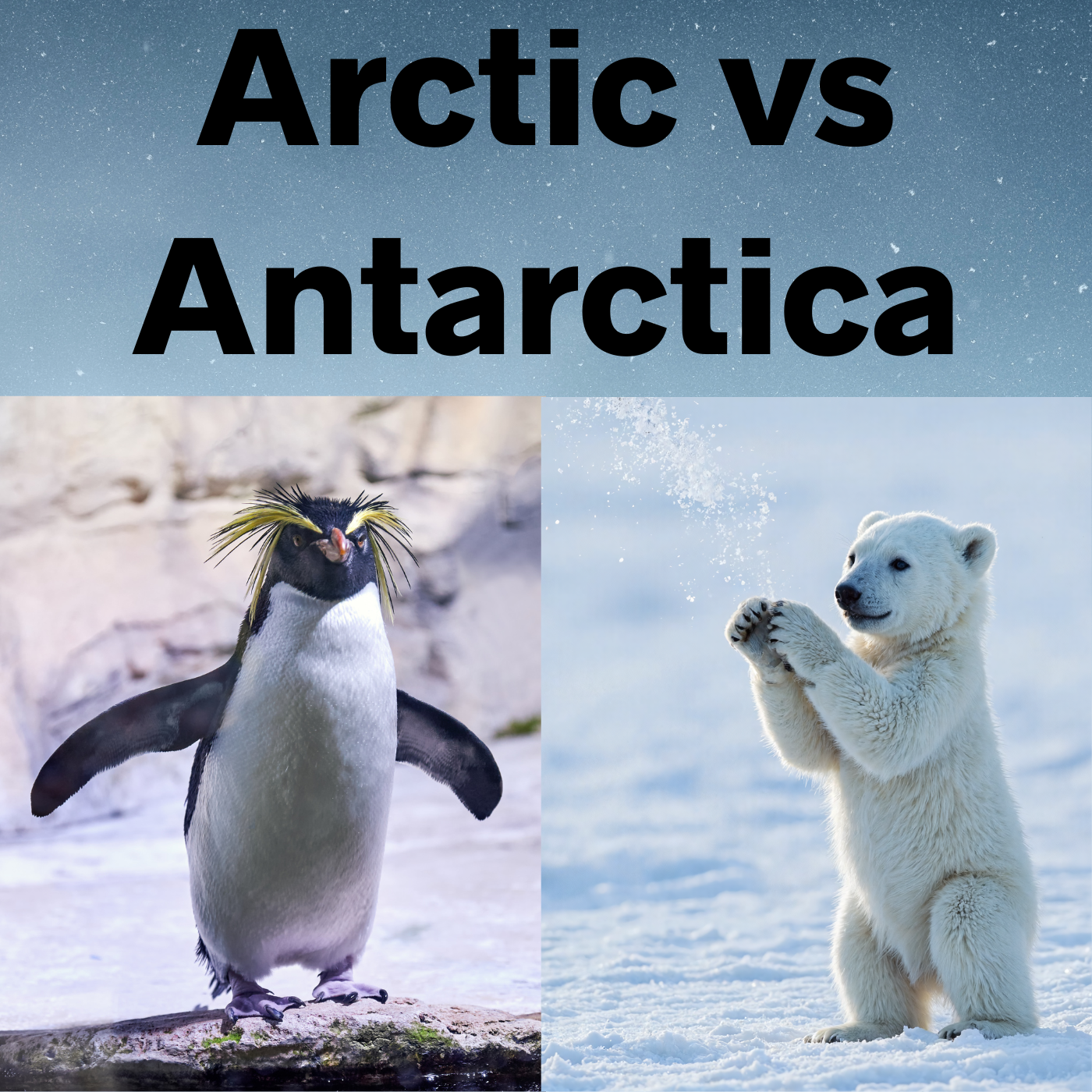
- Arctic: Polar bears, Arctic foxes, walruses, seals, reindeer, whales.
- Antarctica: Penguins, seals, whales, seabirds.
Remember: Polar bears = North, penguins = South.
Human Presence
- Arctic: Indigenous communities (Inuit, Sámi, etc.), towns, research stations.
- Antarctica: No permanent residents; only scientists and support staff.
Useful Vocabulary & Collocations
- Ice sheet
- Sea ice / pack ice
- Ice shelf
- Glacier
- Permafrost
- Tundra
- Sub-zero temperatures
- Harsh environment
- Polar night / midnight sun
- “Extreme conditions”
- “Vast stretches of ice”
- “A fragile ecosystem”
- “Melting ice caps”
- “Climate patterns”
- “Human impact”
- “Scientific research”
- “Wildlife conservation”
Idioms & Expressions
“To be poles apart” (at the opposite end of the spectrum)
- “On thin ice” (in a risky situation)
- “Break the ice” – “An ice breaker” (start a conversation)
- “The tip of the iceberg” (only a small part of a bigger issue)
- “An ice maiden” (a beautiful but cold-hearted woman)
- “A drop in the ocean” (very small compared to what is needed)
- “Frozen in time” (unchanged for a long period)
- “An icy look” (an unfriendly and cold way of looking at someone)
Interesting Facts
- Antarctica holds 70% of the world’s freshwater.
- The magnetic poles and geographic poles are not in the same place.
- The North Pole has no time zone—researchers use whatever time zone they choose.
- Antarctica is technically a desert due to extremely low precipitation.
Discussion Questions
- Which pole do you think would be more difficult to survive in, and why?
- What animals from the polar regions do you find most interesting?
- How might melting ice caps affect the rest of the world?
- Would you ever join a polar expedition? Why or why not?
…and now it’s your turn to practise your English. Would you like to go to the poles? If so, which one? Have you already been? Tell us about it?
Send us a voice message. https://www.speakpipe.com/inglespodcast
Send us an email with a comment or question to [email protected] or [email protected]
If you’re a Spanish speaker and you want to improve your English with free and paid resources, visit the mansioningles website at mansioningles.com and for paid products you can browse the online store at https://store.mansioningles.net/
If you would like a full transcription of this podcast you might consider joining our Patreon program. As a Patreon member, you’ll also get an invitation once a month to join Craig for an informal chat on Zoom to practise your speaking and you’ll have the warm, fuzzy feeling of supporting the podcast. https://www.patreon.com/inglespodcast

In next week’s episode: Concessive Clauses and inversion (strange as it may seem, …try as he might,….etc)
The music in this podcast is by Pitx. The track is called ‘See You Later’