

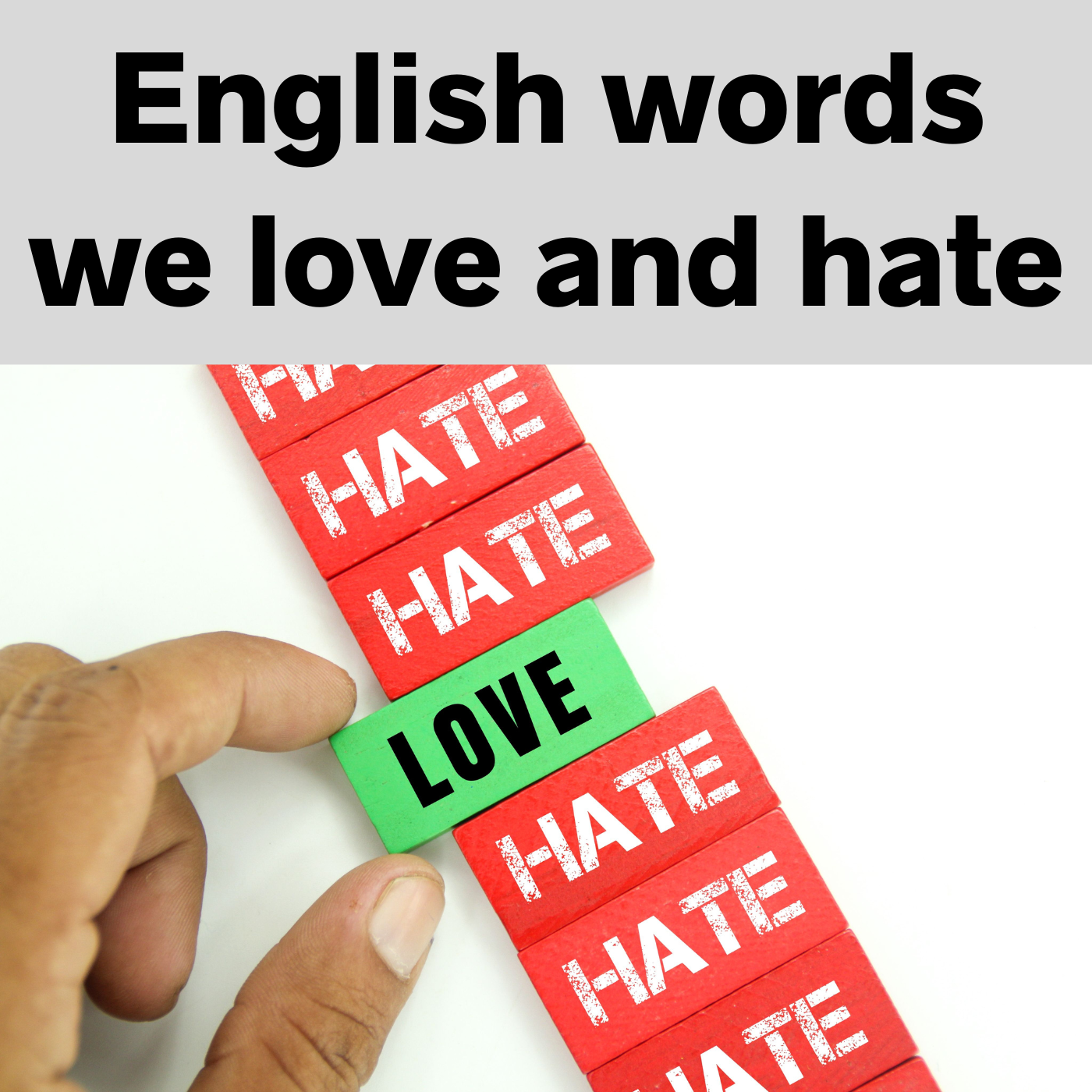
Can you feel a certain way about a word? Do you like some words more than others?
English is full of fascinating vocabulary and today we’re going to talk about words we love and words we dislike. We’ll explore why certain words make us feel good and why others make us uncomfortable.
Words we like
Why do people like certain words?
They sound musical
They feel poetic
They have a connection with a specific significant place/time/person etc.
They express strong or interesting ideas
They are fun to say

Reza’s words
Lovely – it can only be good!
Wee – extremely widely used in Scotland and Ireland; almost part of our identity to use it, rather than little or small
Eejit – also a very Irish word used a lot instead of idiot, often light-heartedly
Quare – another specifically (Northern) Irish word, used very frequently, meaning queer or quite. e.g. Here boy, thon (your) wee man’s a quare eejit, so he is!
Lush – it has a rich sound
Wasps & crisps – because my dad always mispronounced them and we teased him
Melancholy – really I prefer the Portuguese word saudade, but English doesn’t have an exact equivalent. I’m a big fan of Portuguese and Brazilian music.
Craig’s words
Shenanigans – It rolls off the tongue
Also, gobbledegook and hullabaloo
Words that are onomatopoeic
onomatopoeia: https://inglespodcast.com/206
For example, giggle, whisper, burp and quack
Holiday
Bumble bee and butterfly
All swear words
Words we dislike
Why do people dislike certain words?
They sound unpleasant
They are associated with body functions
They are overused
They feel pretentious
They are misused
Craig’s words
Moist
Phlegm, mucus – cringe-worthy, makes me cringe
Shoulder
Smack
War
Like and literally (when used incorrectly)
Reza’s words
Vomit – it also often makes me think of the actual unpleasant act itself
Nasty – sounds nasty!
Vagina – it doesn’t do justice to what it represents; sounds somewhat aloof, considering what it is we’re talking about.
Loser – when meaning a generally unimportant person, as if there were certain accepted ways of being considered successful. It tells you more about the person who says it.
Issue – when used to avoid saying a more useful/direct word. For example, “She has issues she needs to resolve.” What issues?! Psychological problems, bad health, financial problems…?
…and now it’s your turn to practise your English. What are your favourite words in English, and why? Are there any English words you really dislike? Are there words that people overuse in your language?
Send us a voice message. https://www.speakpipe.com/inglespodcast
Send us an email with a comment or question to [email protected] or [email protected]
If you’re a Spanish speaker and you want to improve your English with free and paid resources, visit the mansioningles website at mansioningles.com and for paid products you can browse the online store at https://store.mansioningles.net/

If you would like a full transcription of this podcast you might consider joining our Patreon program. As a Patreon member, you’ll also get an invitation once a month to join Craig for an informal chat on Zoom to practise your speaking and you’ll have the warm, fuzzy feeling of supporting the podcast. https://www.patreon.com/inglespodcast

In next week’s episode: Whilst, though and other linking words
If you enjoyed this podcast, please tell your friends.
The music in this podcast is by Pitx. The track is called ‘See You Later’