


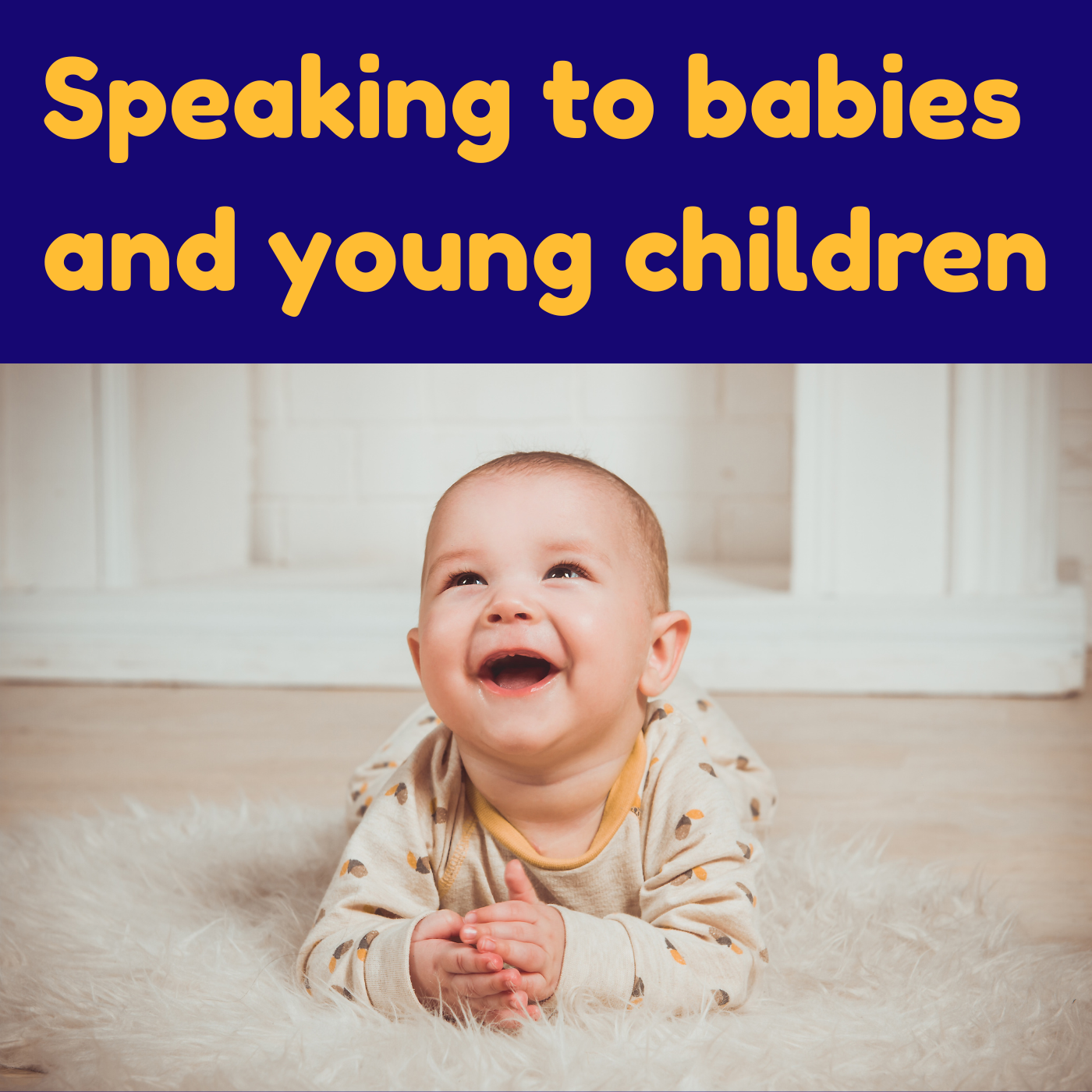
Today we’re going to talk about something very familiar to parents, grandparents, teachers, and anyone who spends time with little children: baby talk.
Baby talk includes the special words, sounds, and games adults use when talking to babies and young children. Scientists call this child-directed speech, and research shows it helps children learn language faster and understand the world around them.
In this episode, we’ll explore common words and phrases, explain why adults simplify language for children, and even share some playful expressions you can try yourself.
Voice message from Marta from Poland
Nursery rhymes for pronunciation practice: https://inglespodcast.com/602
Speaking to babies and young children
Why do adults do it?
Humans are biologically wired to communicate with infants differently.
Even people who have never studied child development or had their own baby before naturally slow down their speech, exaggerate intonation, and simplify words when talking to babies.
This instinct helps capture the baby’s attention and makes language easier to process.
Babies cannot understand complex sentences, but they respond to tone, facial expressions, and gestures.
When adults simplify speech, babies respond by babbling or cooing, reinforcing the behaviour.
Research shows that caregivers worldwide use child-directed speech, even if they’ve never read about it.
Vocabulary and expressions
Peek-a-boo – A game where you hide your face and then show it, saying “Peek-a-boo!”
All gone / All done – Said when finishing a meal or snack.
Nighty-night/ Night-night / Sleepy-time / Go bye-byes – Saying it when putting a baby to bed.
Potty / Toilet – Talking about going to the toilet. (poo-poo, doo-doos, wee-wee)
Nappy / Diaper – Changing a baby’s nappy/diaper.
That’s a no-no
Nana / papa / dada / mama
Cuddles / Snuggles – Physical affection: hugging and holding.
Booboo – Refers to a small injury.
Animal sounds: woof-woof, moo-moo, meow-meow
Nom-nom / Yum-yum / Yummy – For eating or tasting food (‘open wide, here comes the train, aeroplane’)
Coochy-coo – Often said to babies when tickling them
Discussion
Do you think baby talk helps or hinders language development in young children?
Why do you think adults naturally change their tone, pitch, and facial expressions when speaking to babies? Is this instinctive or learned?
How do you feel about adults using simplified grammar with young children? Should adults model “correct” language at all times?
Studies comparing telegraphic speech (“Mommy go store”) with grammatically simplified input (“Mommy is going to the store”) show that children learn better from the grammatical version.
Adults should model correct grammar most of the time.
Children rely on hearing real grammatical structures to learn how language works.
Early years (infancy–toddlers)
Using simplified speech — clear, short, repetitive — helps children focus on linguistic patterns. It doesn’t have to be “perfect grammar,” but it should be consistent and meaningful.
As children grow (pre-school and beyond)
Children benefit from hearing more complex grammar models.
Adults shouldn’t only use simplified forms forever; modelling correct and varied language supports later stages of development.
Correcting errors
Direct correction (“No — say it like this”) is not always necessary and may disrupt communication or confidence. Instead, adults can model the correct form naturally — e.g., if a child says “He go park,” an adult might respond, “Yes, he went to the park.” This teaches without interrupting. (This approach is widely noted in language teaching and acquisition research.)
In short, use natural, warm, simplified language — but keep the grammar intact.
Children learn best from short, clear, grammatically correct sentences delivered in a responsive, engaging way.
…and now it’s your turn to practise your English. How do you speak to your young kids? Do you use ‘baby talk’ in your language? We’d love to hear about your experiences, especially if you have been speaking to your children in English or if you’re considering it.
Send us a voice message. https://www.speakpipe.com/inglespodcast
Send us an email with a comment or question to [email protected] or [email protected]
If you’re a Spanish speaker and you want to improve your English with free and paid resources, visit the mansioningles website at mansioningles.com and for paid products you can browse the online store at https://store.mansioningles.net/

Thank you to our Patreon supporters. Join our Patreon program and you get instant access to the transcriptions of this podcast and live Zoom chats so that you can practice speaking. https://www.patreon.com/inglespodcast

Welcome to our new Patreon supporters who have joined us this month:
Emilio Tamburini
uziv uziv
Samuel Perez
Kendy Aparecido Osiro
María Elisa Alvarez Torres
In next week’s episode: Vowel Sounds in English – Monophthongs & Diphthongs
If you enjoyed this podcast, please tell your friends.
The music in this podcast is by Pitx. The track is called ‘See You Later’