

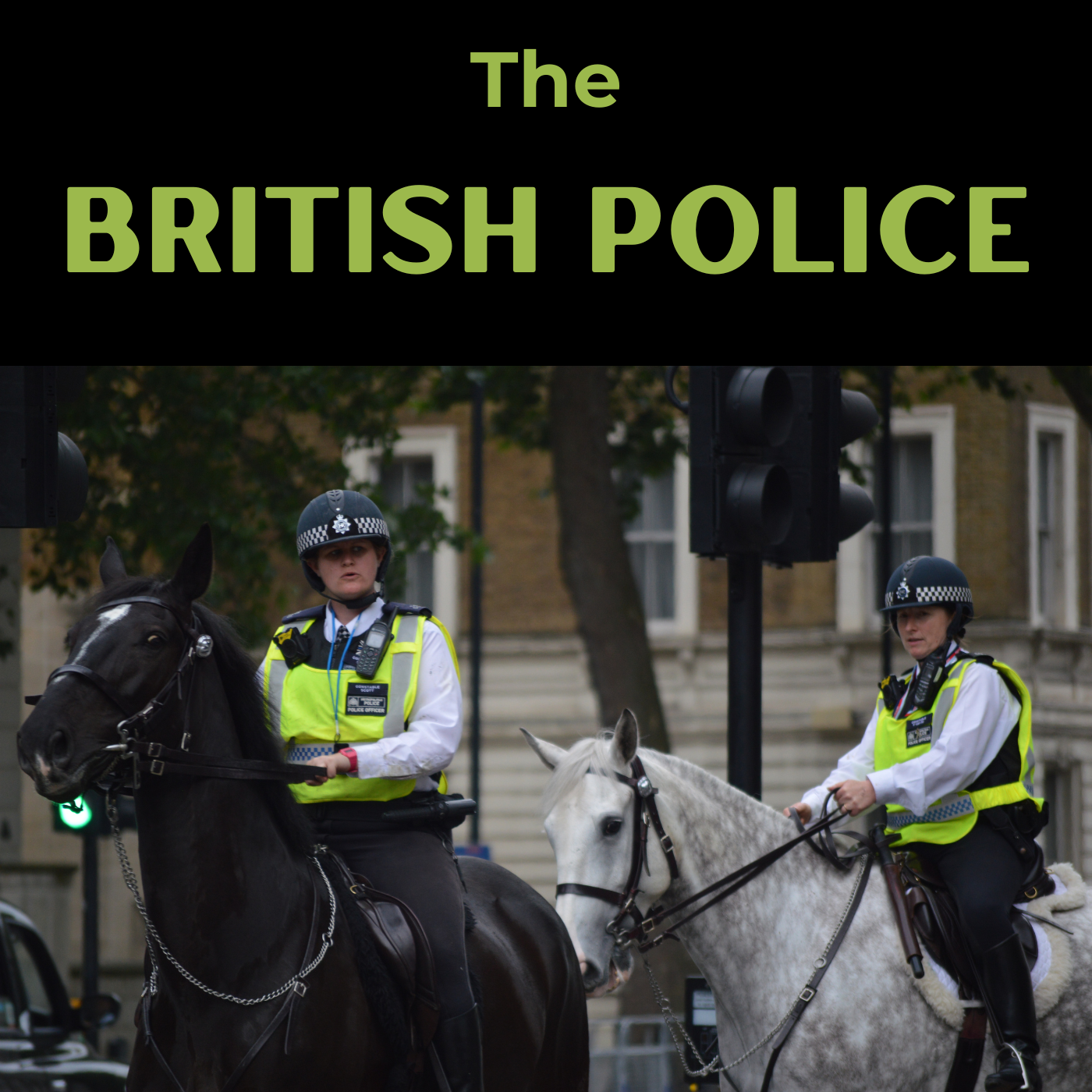
When people talk about the British police, they often imagine one single organisation. In reality, policing in the UK is more complex. The British police system is made up of several different forces, each responsible for a specific region and operating under slightly different laws and traditions.
We’ll explain it to you in this week’s podcast and you’ll learn some vocabulary connected with the police and some interesting facts about them.
Voice message from Jesus from Zaragoza
civil guards (pronunciation)
Crime Idioms: https://inglespodcast.com/412
Prison, Punishment and Criminal Rehabilitation: https://inglespodcast.com/510
The British Police
Sometimes called ‘the force’ in colloquial English.
England and Wales are policed by more than 40 regional forces, including the Metropolitan Police (the Met) in London. These forces follow the same legal system but operate independently. Most British police officers do not carry guns, which is unusual compared to many countries.
Scotland has a single national force called Police Scotland, which was created in 2013 by merging several regional forces.
Northern Ireland is policed by the Police Service of Northern Ireland (PSNI), formerly the Royal Ulster Constabulary (RUC) until 2001, which has a unique history and operates in a more politically sensitive environment. For this reason they tend to be are armed, and flak jackets are standard too for most officers.
Vocabulary
Policing by consent – the idea that police power comes from public approval, not force. The idea of “policing by consent” dates back to 1829, when the modern police force was created.
Unarmed officer – a police officer who does not carry a gun. Sir Robert Peel, the founder of the police, believed police officers should be seen as citizens in uniform.
Stop and search – police powers to stop people and search them for illegal items
Law enforcement – the job of making sure laws are followed
Community policing – working closely with local communities to prevent crime
Body-worn camera – a small camera worn by police officers to record interactions
CCTV (Closed-Circuit Television) – video cameras used to monitor public spaces
Independent investigation – an investigation carried out by an organisation not connected to the police
Transparency – openness and honesty about actions and decisions
Criminal justice system – police, courts, and prisons working together

Interesting Facts
British police officers are often called “bobbies”, named after Robert Peel. (In Northern Ireland “peelers” is a more common slang term.) Other slang terms include “the boys in blue”, “the fuzz”, “the old bill”, “cops” and “coppers”.
Only specially trained units carry firearms (except in Northern Ireland, where it’s standard), such as armed response officers.
The UK has one of the highest numbers of CCTV cameras in Europe, especially in cities.
Body-worn cameras are now widely used to increase transparency and reduce complaints.
Police officers swear an oath to serve the public, not the government.
Stop and search powers are legal, but their use is closely monitored. These stop and search powers have been highly controversial in the UK. Do you think they are necessary for public safety, or do they risk discrimination and abuse?
Recent scandals
West Midlands Football Fans Ban (2025) – The Chief Constable of West Midlands Police retired after intense criticism over the decision to recommend banning fans of an Israeli football team from a match. An independent report found the intelligence used was overstated and included fabricated details, damaging public confidence.
Sectarian bias in policing in Northern Ireland – The Royal Ulster Constabulary was disbanded in 2001, as a condition of the Good Friday (Belfast) Agreement peace deal, after decades of accusations of discrimination against Catholics. This is because the vast majority of officers were Protestant, Catholics being unwilling to enlist in a UK police force.
Met Police Racism and Misconduct Exposed (Panorama Documentary) – A BBC investigation uncovered serving officers exhibiting racism, misogyny, and even calls for violence; several officers were suspended and the force apologised for the conduct.
Do you have any interesting information or anecdotes about the police where you live? Get in touch and let us know.
Reza will never forget how his 19-year-old neighbour, Stephen, was blown up into pieces by terrorists while in his first few days(!) working as a policeman in Northern Ireland in 1985. Or how a suspect device was attached to a neighbour’s parked car, just because he was a police officer, in his street and had to be defused, also in the 1980s. Or seeing police officers regularly armed with sub-machine guns patrolling neighbourhoods.
Let’s never forget that it can be an extremely dangerous job.
…and now it’s your turn to practise your English. Tell us your stories of encounters with the police in your country or abroad. And if you are a policeman or woman, active or retired like Jesus, we’d love to hear any interesting or curious stories you might have to share.
Send us a voice message. https://www.speakpipe.com/inglespodcast
Send us an email with a comment or question to [email protected] or [email protected]
If you’re a Spanish speaker and you want to improve your English with free and paid resources, visit the mansioningles website at mansioningles.com and for paid products you can browse the online store at https://store.mansioningles.net/

Thank you to our Patreon supporters. Join our Patreon program and you get instant access to the transcriptions of this podcast and live Zoom chats so that you can practice speaking. https://www.patreon.com/inglespodcast

Welcome to our new Patreon supporters who have joined us this month:
Emilio Tamburini
uziv uziv
Samuel Perez
Kendy Aparecido Osiro
María Elisa Alvarez Torres
In next week’s episode: Speaking to babies and young children
If you enjoyed this podcast, please tell your friends!
The music in this podcast is by Pitx. The track is called ‘See You Later’